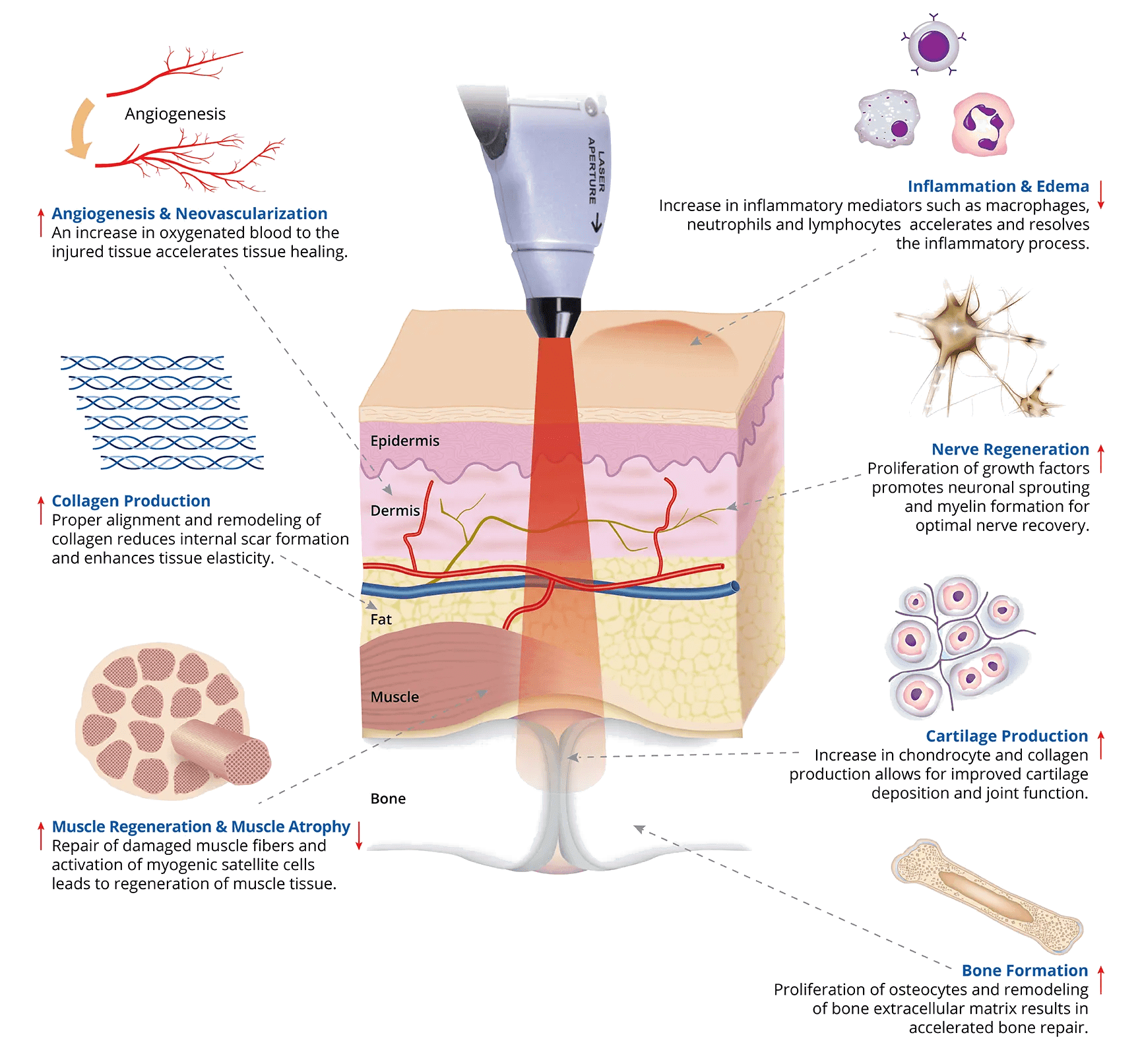
Did you know that the theory behind laser was developed by Albert Einstein as early as 1916! It was only more than 50 years later that the therapeutic effects of laser were discovered by Hungarian physicist and surgeon Endre Mester. By accidentally discovering that laser can assist in hair regrowth in mice, a new light therapy was born: photostimulation, also known as photomodulation. This involves cellular activation through light. Laser acupuncture targets acupuncture points (穴位) to perform this stimulation in a safe, effective, and painless manner.
The term laser is an acronym for light amplification by stimulated emission. The expression thus means: amplification of light by the stimulated emission of radiation.
The technologies specifically useful for pain treatment became accessible at the end of the 1970s and have been used since then around the world by healthcare professionals in various clinical situations. The devices originally did not have the power of current tools and could only treat superficial skin lesions, since the radiation was only capable of penetrating the skin superficially.
Current photostimulation devices allow for treatment of a variety of musculoskeletal disorders of an inflammatory nature, such as osteoarthritis, acute and chronic pain, fibromyalgia, etc.
LASER can also be used in acupuncture to reach acupuncture points beneath the skin, thus allowing not only local treatments at the site of the problem, but also treatments targeting dysfunction of internal organs through the use of reflex pathways, such as in auriculotherapy treatments, or through the meridian systems (经络) specific to acupuncture.
2 Light Wavelengths Used in Alternation
In contrast to devices using only a single wavelength (often in the red spectrum), devices such as Bioflex or Biophoton allow for stimulation in turn using red and infrared radiation. Alternating wavelengths over time would allow for better absorption by living tissues. Additionally, the use of different wavelengths would allow for reaching different levels of tissue penetration and a variety of therapeutic aims.
Thus, red radiation would work more superficially than infrared. Infrared would have a penetration capacity reaching several centimeters, which would therefore be similar to an acupuncture needle in terms of depth. Devices using only a single wavelength (i.e., in the red spectrum only, such as certain RJ Laser) cannot reach the penetration depth of infrared radiation.
Devices that combine multiple wavelengths simultaneously (i.e., some Biophoton models) have the reputation of emitting radiation that would be less well absorbed by tissues than those using wavelengths in turn—thus one at a time—different wavelengths (i.e., Bioflex and some Biophoton models).
The tools used at Clinique Shanti to administer laser acupuncture treatments are all Bioflex devices, which use red AND infrared radiation in alternation. This is in fact a safe technological evolution of acupuncture practice - moxibustion.
>
>
>
#acupuncture #laser also for #children / also for #kids
>
A post shared by Clinique Shanti (@cliniqueshanti) on Feb. 23, 2017 at 2:06 PM PST
>
The Use of Pulsed Laser Light in Laser Acupuncture
Called to develop further through more in-depth research, the use of different frequencies for various well-defined applications of phototherapy has already been associated with various specific clinical effects. Measured in Hertz, frequency means the number of pulses/seconds. i.e.: 10 Hertz = 10 pulses/seconds = anti-inflammatory effect) Current photostimulation devices rely, for part of their claims, on these concepts of therapeutic frequencies and protocols often distinguish themselves by the use of different frequency modulations depending on clinical applications.
LASER used in acupuncture is safe. Nothing to do here with invasive X-rays or microwaves, since the radiation used for LASER acupuncture is non-ionizing. There are therefore no side effects. The only contraindications: avoid the eyes, as well as the first trimester of pregnancy.
 **Laser works through photo-biostimulation.
This is the activation of cellular ATP through photostimulation, the energy of light!**
**Laser works through photo-biostimulation.
This is the activation of cellular ATP through photostimulation, the energy of light!**
Different photosensitizing agents can be used to catalyze the effect of laser acupuncture treatments. Dr. Weber, who works with several different wavelengths, includes photosensitizing agents specific to certain protocols: i.e. curcumin, chlorella, chlorophyll, spirulina, etc. Several factors influence the degree of penetration of radiation: the wavelength used, the frequency and power used, the application technique, the patient's skin tone, the exposure time (dose of photons—particles of light—), etc.
Laser acupuncture by infrared radiation, the technological evolution of moxibustion
**
Laser acupuncture can restore optimal blood circulation, sometimes even more effectively than acupuncture.(2)
The American College of Physicians presented, in early 2017, clinical guidelines regarding treatment of acute, subacute, and chronic low back pain. The integrative, medication-free approach is recommended. Acupuncture is part of the recommendations for all types of low back pain, while laser is part of the recommendations for chronic low back pain.
 The Bioflex system used at Clinique Shanti is approved by Health Canada
One of the mechanisms put forward to explain the clinical effects of LASER would be the functional activation of the mitochondria inside the living cell. Light stimulation would allow the mitochondria to generate more ATP: the energy generated by the cell. This involves activation of cellular energy through light!
References
(1) Laser acupuncture for treating musculoskeletal pain: a systematic review with meta-analysis.
(2) Effectiveness of Laser treatment at acupuncture sites compared to traditional acupuncture in the treatment of peripheral artery disease. Conf Proc IEEE Eng Med Biol Soc. 2010;2010:1262-5. doi: 10.1109/IEMBS.2010.5626418.
(3) Evaluation of low-level laser at auriculotherapy points to reduce postoperative pain in inferior third molar surgery: study protocol for a randomized controlled trial. Trials, 2016 Sep 2;17(1):432. doi: 10.1186/s13063-016-1540-9.
(4) Noninvasive Treatments for Acute, Subacute, and Chronic Low Back Pain: A Clinical Practice Guideline From the American College of Physicians, Annals of Internal Medicine, 14 February 2017
(5) Tuner J, Hode L. Low level laser therapy—clinical practice and scientific background. In: Turner J, Hode L, eds. –Low Level Laser Therapy—Clinical Practice and Scientific Background. Spjutvagen, Sweden: Prima Books;1999:101-104.
(6) Sattayut S, Hughes F, Bradley P. 820 nm gallium aluminium arsenide laser modulation of prostaglandin E2 production in interleukin-1 stimulated myoblasts. Laser Ther. 1999;11:88-95.
(7) Bjordal JM, Johnson MI, Iversen V, et al. Photoradiation in acute pain: a systematic review of possible mechanisms of action and clinical effects in randomized, placebo-controlled trials. Photomed Laser Surg. 2006;24:158-168.
(8) Chow RT, David MA, Armati PJ. 830 nm laser irradiation induces varicosity formation, reduces mitochondrial membrane potential and blocks fast axonal flow in small and medium diameter rat dorsal root ganglion neurons: implications for the analgesic effects of 830 nm laser. J Peripher Nerv Syst. 2007:12:28-39.
(9) World Association of Laser Therapy. Consensus agreement on the design and conduct of clinical studies with low-level laser therapy and light therapy for musculoskeletal pain and disorders. Photomed Laser Surg. 2006:24:761-762.
(10) Dundar U, Evcik D, Samli F, Pusak H, Kavuncu V. The effect of gallium arsenide aluminum laser therapy in the management of cervical myofascial pain syndrome: a double-blind, placebo-controlled study. Clin Rheumatol. 2007;26:930-934.
(11) Chow RT, Johnson MI, Lopes-Martins RAB, Bjordal JM. Efficacy of low-level laser therapy in the management of neck pain: a systematic review and meta-analysis of randomised placebo or active-treatment controlled trials. Lancet. 2009;374:1897-1908.
(12) Travell JG, Simons DG. Myofascial Pain and Dysfunction. The Trigger Point Manual. Volumes 1 and 2. Media, PA:Williams &Wilkins; 1983 and 1992.
Acupuncture can help you.
Book Appointment