Artemisia: The Apothecary Across Borders
✈️ An Overview of Several Notable Artemisia Species
In 2015, the Nobel Prize was awarded to Tu Youyou, whose research in the fight against malaria was crowned with success, leading to the discovery of artemisinin, a component of the Artemisia Annua plant demonstrated to be active against malaria.
>
The traditional use of Artemisia Afra, the variety indigenous to Africa, which does not contain artemisinin, is nevertheless presumed to be effective in the field as an antimalarial. -Malaria Business, France 24, 2019
In 2020, Covid-19 takes the planet hostage. Following apparent conflicts of interest and contradictory advice from the WHO, some nations reportedly decided to withdraw their support, shortly after the temporary freeze on American funding to the World Health Organization. One of the points of tension, notably for several African countries, including Madagascar's president Andry Rajoelina, concerns a controversial traditional remedy regarding its therapeutic claims concerning coronavirus (Covid-19). The remedy was developed during the pandemic on the mother continent, based notably on Artemisia extracts.
The Etymology of the Genus Artemisia
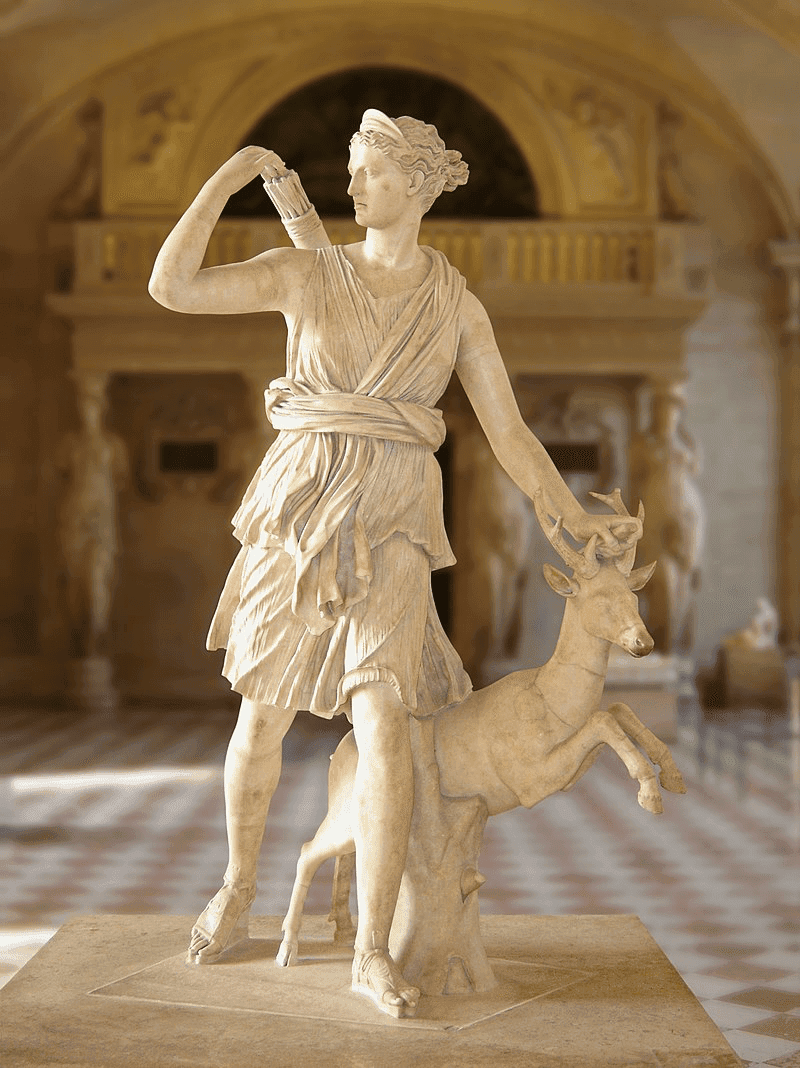
Derived from Latin artemisia → see Artemis, goddess of nature and wild animals, the huntress with golden arrows.
"Artemis (in ancient Greek Ἄρτεμις / Ártemis) is, in Greek mythology, the goddess of wild nature, hunting, childbirth and one of the goddesses associated with the Moon along with Hecate and Selene … She has the power to cause epidemics and conversely has the power to heal. She is also the cause of sudden deaths and the illness that takes women in childbirth. She is protector of roads and ports, of very young children and baby animals. Her cults related to the major moments in a woman's life: her birth, puberty and death … She also wanders in the agros, fallow lands, uncultivated and infrequently visited areas… she "has her place on the edge of the sea, in coastal zones where between land and water the boundaries are indecisive." … She is also at the head of a troop of 20 nymphs from Mount Amnisos and young mortal women, whom she leads through the forests. The Iliad speaks of her as "the rustic Artemis […], the lady of wild beasts …"
Botanical Family of Asteraceae
Artemisia can actually refer to several medicinal herbs used throughout the world. Artemisia would actually comprise between 200 and 400 species. The few medicinal species discussed here include:
Artemisia Absinthium (Absinthe or wormwood)
Artemisia Vulgaris (Common mugwort or mugwort)
Artemisia Abrotanum (Southernwood or lemon-scented mugwort)
Artemisia Tridentata (Three-lobed sage or sagebrush)
Qīng Hāo 青蒿 (Generally Artemisia Apiacea but also Artemisia Annua)
Ài yè 艾葉 (Artemisia Argyi H.Lév. & Vaniot)
Yīn Chén Hāo 茵陈 (Artemisia Capillaris)
In addition to their medicinal uses for internal applications, one of these mugworts, A. Argyi (ài yè, 艾葉), constitutes the best type of Artemisia, in external use, for the practice of acupuncture - moxibustion, a multi-millennial integrative medicine.
*Artemisia Vulgaris (Common mugwort)*

Artemisia Abrotanum
(Southernwood or lemon-scented mugwort)*

*Artemisia Tridentata (Three-lobed sage or sagebrush)*
Artemisia From Here and Elsewhere
In the West, Artemisia Absinthium (Absinthe) has been used since Dioscorides for gastrointestinal, hepatobiliary and gynecological disorders

*Artemisia Absinthium (Absinthe or Wormwood#/media/Fichier:Artemisia_absinthium_-_K%C3%B6hler%E2%80%93s_Medizinal-Pflanzen-164.jpg))*
Absinthe can be useful in chronic fatigue syndrome, fibromyalgia, food intolerances, rehabilitation of patients with prolonged substance or multiple medication abuse, menstrual disorders with nervous tension and depression. Absinthe and common mugwort are sometimes interchangeable in use. Common mugwort is considered weaker than absinthe. A. Abrotanum is less commonly used but also useful for menstrual disorders. Indigenous peoples of the Americas used A. Tridentata for colds and as a foot bath for foot pain.
️ TEMPERATURE
Although absinthe and common mugwort are classified as having variable temperature properties, they are primarily used for conditions of systemic heat. Notably in cases of liver damp-heat, heat from deficiency, and conditions presenting after infection with residual heat. Note that common mugwort is more neutral than absinthe.
FLAVOR
Absinthe is strongly bitter, which makes it a plant that regulates gastrointestinal and hepatobiliary functions. Common mugwort is less bitter and less aromatic.
ACTIONS
Drains deficiency heat: intermittent or chronic fever (not acute plethora-heat fevers). Said to drain "retained pathogens"
General and digestive tonic, vermifuge, hepatic, strengthens the blood, emmenagogue, useful in amenorrhea, infertility, low libido, tranquilizing, anticonvulsant, antispasmodic
Mugworts regulate a cold uterus, by calming spasms and menstrual irregularities as well as by moving and strengthening the blood at the level of the uterus
Disperses the liver and calms yang and the heart; calms irritability and useful for depression, headaches, anxiety
*Artemisia Absinthium is used in the formulation of Absinthe*
☠️ TOXICITY
Be cautious of the concentration of thujone in alcohol distillates and especially in essential oils. It was once believed that thujone was responsible for the toxicity of the beverage nicknamed the green fairy. We now know that alcohol is probably the most toxic ingredient in this beverage. Concerns about thujone toxicity—at high doses—stem from the history of abuse of spirits with very high alcohol content that were distilled with A. Absinthium. The process concentrates the essential oils of the plant, increasing thujone concentrations to levels much higher than those measured in a typical infusion or therapeutic tincture of absinthe.
⚠️ WARNING
Some countries require labeling of thujone concentration on alcohol-based products containing absinthe. Use of the essential oil as such is restricted in several countries. Thujone overdose could result in discomfort and dangers: dizziness, insomnia, nightmares, vomiting, convulsions, intestinal cramps, urinary retention, and kidney damage in severe cases.
A. Absinthium presents no toxicity in infusion, but it could however aggravate patients suffering from gastric acidity due to its very bitter character.
Some authors prohibit mugwort during pregnancy and breastfeeding, especially A. Absinthium and A. Abrotanum (lemon-scented mugwort)
Absinthium and Abrotanum have no recorded use in Asia according to the Chinese Herbal Dictionary
Artemisia in China
Several species of Artemisia are used by Traditional Chinese Medicine (TCM)
Qīng Hāo 青蒿 (Artemisia Apiacea but also Artemisia Annua)
️ TEMPERATURE
Cool or cold
FLAVOR
Bitter and acrid
HARVEST
In summer or autumn
⚡ MERIDIANS
Liver and Gallbladder
ACTIONS
Like Absinthe, Artemisia Apiacea is used for febrile conditions. However, Apiacea is useful for all types of fever, including malaria, thus both plethora-heat and heat from deficiency
CONTRAINDICATION
Artemisia is contraindicated for postpartum women who are in blood deficiency or spleen/pancreas deficiency with internal cold
Yīn Chén Hāo 茵陈 (Artemisia Capillaris)
️ TEMPERATURE
Neutral or slightly cool
FLAVOR
Bitter
⚡ MERIDIANS
Spleen, stomach, liver and gallbladder
HARVEST
In summer or autumn
ACTIONS
Eliminates damp-heat, dissipates jaundice
Useful in the treatment of viral hepatitis
Anticoagulant

*
Liquid extract of Artemisia Capillaris (茵陈 Yīn Chén Hāo)*
First documented in The Divine Husbandman's Herbal Foundation Canon 神農本草經 shén nóng běn cǎo jīng in the context of treating liver diseases
Like Absinthe, Artemisia Capillaris can be useful for treating warm or cold hepatobiliary conditions
Useful in cases of eczema and itching
CONTRAINDICATION
Jaundice accompanied by deficiency in the middle burner (spleen/pancreas)
Ài yè 艾葉 (Artemisia Argyi)

*
Artemisia Argyi (艾葉 Ài Yè)*
️ TEMPERATURE
Warm to hot
FLAVOR
Bitter and acrid
⚡ MERIDIANS
Liver, spleen, kidneys
HARVEST
Argyi is harvested in spring or summer before flowering
ACTIONS
Stops bleeding (once roasted and carbonized)
i.e. postpartum hemorrhage, uterine bleeding, menorrhagia
Disperses cold
Calms pain
Warms the meridians
Eases respiratory difficulty and cough
Expels phlegm
Useful for treating dermatoses and eczema, in decoction or fumigation for local use
Dysmenorrhea, pelvic/epigastric/abdominal pain of cold type
Inhibits platelet aggregation
Artemisia Argyi and Abrotanum demonstrate antiallergic activity
When considering Ài Yè as A. Vulgaris, the primary use here is for women's health disorders of cold and deficiency type, such as threat of premature labor
According to authors, A. Vulgaris and A. Argyi could sometimes be confused and Vulgaris is sometimes used as a substitute for Argyi (Ài Yè, 艾葉)
Used for a long time as a stimulant to activate the return of menstruation, facilitate childbirth and the expulsion of lochia
Artemisia Argyi is used in the traditional conditioning of the plant allowing the fabrication of the moxibustion tool applied in the context of acupuncture-moxibustion practice
CONTRAINDICATION
Internal use: To be used with caution in the presence of heat in the blood or yin deficiency
External use: Targeted external applications of Artemisia Argyi through acupuncture-moxibustion practice is prohibited for patients who present signs of heat, whether plethora-heat internal or heat secondary to yin deficiency

*
Moxibustion rolls, manufactured using Artemisia Argyi*
✍ About the Author
Olivier Roy, Acupuncturist. As of 2020, Olivier Roy has 16 years of experience as a health care professional. The last 13 years have been dedicated to the clinical practice of acupuncture, including obstetric acupuncture, pediatric acupuncture, acupuncture within fertility protocols, acupuncture for sports performance, acupuncture in sports injury rehabilitation for professional athletes, but also those who do it in their living room, retirees who have decided to remain active, and also travelers, who have come from afar to find Quebec expertise in acupuncture. Olivier Roy maintains a busy practice in Montreal and also regularly administers acupuncture treatments to patients in a hospital setting.
REFERENCES
(1) Combining Western Herbs and Chinese Medicine Principles, Practice and Materia Medica, Jeremy Ross, Greenfields Press, 2003
(2) Pharmacopoeia and Traditional Chinese Medicine, Chinese Plants – Western Plants, Dr. G. Guillaume, Dr. Mach – Chieu, Éditions DésIris, 1987
(3) Yellow Emperor's Inner Canon Huangdi Neijing 黄帝内经
(4) Characteristics, clinical effect profile and tolerability of a nasal spray preparation of Artemisia abrotanum L. for allergic rhinitis, Remberg P, Phytomedicine, 2004 January
Acupuncture can help you.
Book Appointment