*
Electromagnetic modeling makes it possible to answer certain aspects of how acupuncture needles function.
The results of acupuncture treatments are increasingly being documented, analyzed and applied in various settings, including hospital intervention units and multidisciplinary teams. But what about the modus operandi, the functioning of acupuncture treatments? This is the question we will attempt to answer in this five-part series of articles.
Several modalities used in medicine are still employed today because they work, without necessarily having a complete understanding of the reason for their efficacy. Such is the case with acetaminophen! Indeed, the complete mechanism of action of acetaminophen remains largely unknown more than a century after its discovery. (1)
It has long been stated that acupuncture acts primarily on the circulation of energy ('Qi' 气) and blood. Assuming that one aspect of 'Qi' is electrical in nature, let us see how the acupuncture needle can act on the circulation of electricity and blood in the human body.
>
>
>
A post shared by Clinique Shanti (@cliniqueshanti) on March 4, 2017 at 11:09 AM PST
>
>
THE ACUPUNCTURE NEEDLE: BOTH A MAGNET AND A DIODE
First, let us establish that the acupuncture needle could be partly compared in its action to a magnet, as well as to a diode. (Before losing some readers; A diode is simply a resistance in an electrical circuit. Imagine the electrical circuit as a river. Like the needle, a Canadian beaver can divert the current of its river in its most transformative action, but more often it will simply reduce the flow of water at one point in the river. The river will continue to flow no matter what the beaver does with it. But the river will at least be slowed in its course, and at most it will be redirected.) Conversely, acupuncture points are reputed to be sites of lower electrical resistance, which can easily be measured using a measuring device useful to electricians, the ohmmeter. These are therefore points of acceleration in the course of current circulation. Using our river mental image, acupuncture points are located on all the smallest slopes of the riverbed terrain downstream, all the way to Niagara Falls: they are the places of slopes and ravines of the river.
Thus the harmonizing effect of the needles (diodes) acts by restoring resistance to sites of lower resistivity—the weaker zones—of the organism: the acupuncture points. The bi-metallic alloy of the acupuncture needle, as well as its handle made of highly conductive solenoid material, also acts as a magnet whose poles can be polarized or depolarized at will depending on the manipulations (movements, applications of heat) made to the needle; it can then act on the electromagnetic fields of its surroundings, in a manner positively proportional to the paths of least resistance for conduction from one point to another. The manipulation of the needle then results in:
1. an action of gathering charges, or
2. an action of diffusion of electrical charges.
Coincidentally, in the human body, our red blood cells contain IRON. Iron is ferromagnetic: the magnetic moments of iron atoms align under the influence of an external magnetic field and retain their new orientation after the field disappears (2)
Furthermore, the center of our blood cells is like planet Earth; convection currents in the outer layer of Earth's outer core, a liquid "alloy" mainly of iron-nickel, are thought to be the origin of Earth's magnetic field...
 Earth's magnetic field
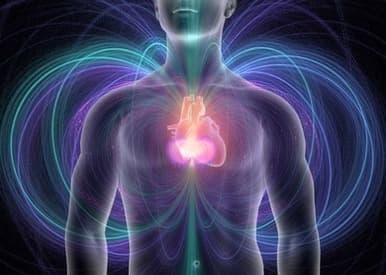
In humans, the heart would be the center of the most intense electromagnetic emissions recorded in the human body's fields...and not the brain as some might have thought!..
Modeling of the human electromagnetic field
Electromagnetic fields in nature by rte_france
#### Biostatistics and acupuncture

Several studies (5) describe the cerebral hemodynamic response (blood movement in the brain) in response to the stimulation used in acupuncture on the needles. With functional magnetic resonance imaging as support, they propose an explanation for the positive results observed in psychiatric and neurological disorders based on the reflex blood irrigation of different brain areas affected by acupuncture treatment. (6)
Faraday's law explains how the medical technology of the traditional type acupuncture needle can act as a magnet because of the solenoid that makes up its handle. The needle made with a plastic handle, based on the hypodermic needle (syringe) model, would not have the same electromagnetic properties as the bi-metallic acupuncture needle with its solenoid handle. Plastic is a material with very low conductivity. The electrical activity of these needles with plastic handles would be limited to circuits between grouped needles and to the bipolar couple of body/tip.
Acupuncture needles have rather 5 known actions
1. Electrical (couplings, diodes, bipolar systems; 1. handle/body and 2. body/tip)
2. Electromagnetic (solenoid)
 SOLENOID at the handle of a copper-steel acupuncture needle
3. Mechanical (cell lysis, action on the connective tissue system, muscle chains, etc.)
4. Biochemical (adenosine, etc.)
5. Systemic (reflex pathways of micro-systems, meridians, nervous reflex pathways, etc.)
We will eventually explore the 4 other fundamental mechanisms (electrical, mechanical, biochemical and systemic) in the continuation of this 5-part file, which presents the fundamental elements of the modus operandi of acupuncture treatment.
The effect of acupuncture treatment can sometimes be only local but it is in fact often of systemic scope, both in techniques and in expected results; it all depends on the clinical picture. When administering an acupuncture treatment, it would be permissible to address a wide spectrum of the patient's clinical reality: i.e. for shoulder pain, one could simultaneously address anxiety or headaches with minimal invasive interventions.
Let us return to Faraday's law, as we are skimming over today the electromagnetic dimension of the effect of acupuncture…What was Mr. Faraday trying to tell us when he spoke of the effect of wrapping a conductive wire, a 'coil' (solenoid) such as that found at the top of acupuncture needles?
THE SOLENOID
This coil could serve to influence the electromagnetic field of its environment, by acting as a magnet! Now, at the center of each of our red blood cells, our cells responsible for transporting oxygen, is found an iron core. Remember, iron is ferromagnetic. This is what is used to make the magnets that stick to the refrigerator. The more ferromagnetic iron there is, the stronger the magnet is: You can even lift automobiles with very strong magnets! Therefore, the acupuncture needle acts as a magnet in interaction with a multitude of other "magnets" that can be redirected at will: our blood cells, the vehicles of oxygen and nutrients intended for all the cells of our organism!
An example of hemodynamic control—the term used to describe the movements and volumetric orientations of blood—of acupuncture needles on blood has been demonstrated by various experiments measuring hemodynamic activity by imaging following acupuncture treatments.(5) (6) They demonstrate how the stimulation of a reflex point, at a distance—a technique specific to acupuncture and applied daily in acupuncture clinics—on the leg or hand, could modulate the preferential blood irrigation of different specific brain areas, a reflex consequence of stimulation of acupuncture needles at acupuncture points. The differences observed are subtle but might they allow us to establish a basis for characterizing and differentiating the various stimulated points? Probably, but I await with even more impatience further similar studies on the effect of networks of points traditionally associated: the famous point prescriptions. It would be interesting to test different needles and further elucidate the mechanisms activating these responses.
 Functional magnetic resonance imaging of differential cerebral hemodynamism for 3 acupuncture points. (7)
The action of stimulating, with the acupuncture needle, the response of the organism, until either the therapist, the patient, or both, perceive the arrival, the mounting and the therapeutic directivity to be given to the movement initiated by needle stimulation: This is called 'de qi' (得气). For example, for a headache, as blood often flows upward in this imbalance, the movement of desirable therapeutic hemodynamism will be downward. One could also refer to this in terms of Oriental medicine by the action of draining heat, yang, or humidity, and the movement of blood is often involved implicitly.
 Functional magnetic resonance imaging of Deqi stimulation (8) Note the geometry of the torus in the anatomy of the cerebral hemispheres.
An interesting property to note of the iron transported by red blood cells. Iron is ferromagnetic; the magnetic moments of atoms align under the influence of an external magnetic field and retain their new orientation after the field disappears. Thus, the reorientation proposed to hemodynamism by the needle remains effective, until a stimulus acting with more intensity influences the magnetic moments of the atomic nuclei of blood again to reorient them again…
 Note the geometry of the torus again present, here in the representation of red blood cells
When you insert the needle, you create a magnetic field in one direction, and when you withdraw it you create the same magnetic field but in the opposite direction. Hence the importance of the gesture and the consequence of the withdrawal of the dam, to return to the terms of the analogy of the beaver and its reworking of the riverbed.
For example, one can thus suppose that by inserting the needle in stages or in spurts one tonifies; one would then have to withdraw the needle rapidly and vigorously. (3)

Research on magnetic phenomena has found that using the two poles of a magnet, either the North side or the South side in therapy, would give different effects. This research is based on the fact that in an oriented magnetic field, the magnetic flux seems drawn in at the South pole level and seems to come out as a water jet at the North pole level. For Nakagawa, in 1972, no data could support the thesis of A.R. Davis et al, according to which the South pole has a calming effect and the North pole a stimulating effect.
In 1979, J.B. Baron specified the different effects of the North and South fields of magnets:
the North field would decrease muscle tonic activity and would be "cholinergic",
the South field would increase muscle tone, would have an anti-inflammatory, anti-edema action, "dopaminergic", and a predominantly analgesic predominance.
Note that magnetism, electricity and gravitation are considered the three main forms of extra-atomic energy in the universe.
A bit of history
In the practice of injecting trigger points, and then subsequently stimulating them using empty syringes, the solenoid component would not have been inscribed in the paradigm of this biostimulation act. The act of injecting muscles would have been described in this paradigm for the first time by Porritt in 1931. On the other hand, since the theoretical and practical paradigm of dry needling was developed from dry syringes with plastic handles, would not the dry needle with plastic handle be the modality specific to this practice, as well as all those that call themselves #notacupuncture?

Regarding the solenoid handle and the bi-metallic alloy of the acupuncture needle
The traditional acupuncture needle actually acts both as a magnet and a diode because of its solenoid handle, constructed on a bi-metallic alloy with the needle body; this is what creates both the electrical resistance and the potential difference making it possible to characterize the electromagnetic properties of the medical technology of the acupuncture needle; properties that cannot be neglected in applications, among others, of the superficial punctures typical of acupuncture, which act on the electromagnetic field of the living: the equivalent of the energy layers described in Oriental tradition...The bi-metallic nature, the solenoid handle of the acupuncture needle, as well as their properties, are inscribed in the history and traditional practice of acupuncture.

Thus reference is made to the solenoid in traditional works by referring notably, among others, to the energetic functions of the concept of "dragons", of "fire". Indeed, we know today that the application of external sources of heat would capacitate, modulate, and in a quantifiable manner, the electromagnetic functions here made explicit of the acupuncture needle. We arrive more often today in clinical practice by the application of electromagnetic heat using specialized lamps above acupuncture needles, but many acupuncturists still use different traditional techniques of moxibustion to warm the points, the acupuncture needle, or both at once, through the combustion of dried mugwort. This is why some also prefer the image of the hydroelectric dam to the analogy of the beaver dam to speak of needles. A heated needle probably comes closer to the hydroelectric power station; in both cases we remember that it is an image that refers to the activation of potential energy.

In clinical practice, various LASER radiations can also be applied to needles to direct capacitation by pulsed light. Electrical stimulation using a TENS device is also one of the targeted and effective techniques, allowing in particular an amplification of the electrical current circulating in the needle as well as a rhythmic shock to the treated muscle areas.
The medical technology of acupuncture needles as we know them today would have been described for the first time 200 years before the Common Era in the Yellow Emperor's Inner Classic.

References
(1) J. Bonnefont, J. P. Courade, A. Alloui and A. Eschalier, "Mechanism of the Antinociceptive Effect of Paracetamol", Drugs), vol. 63, no. 2 (Spec), 2003, p. 1-4 (ISSN 0012-6667 and 1179-1950, PMID 14758785, read online [archive])
(2) "...the magnetic moments of atoms align under the influence of an external magnetic field and retain their new orientation after the field disappears." https://en.wikipedia.org/wiki/Iron
(3) See works by Dr. Mussat, radiologist turned acupuncturist. Reported by Pierre Moal, La Revue Française de Médecine Traditionnelle Chinoise 1993, 157, 110-117
(5)Electroencephalogram activity induced by magnetic stimulation on heart meridian.
(6)Effects of acupuncture on the brain hemodynamics.
(6) Acupuncture mobilizes the brain's default mode and its anti-correlated network in healthy subjects:
(7)"Fig. 1 – BOLD fMRI during acupuncture at 3 acupoints performed in randomized order (LI4 64 runs/37 subjects, ST36 74/43, LV3 63/37). Clusters of deactivated regions appeared at the mid and ventral levels of the MPFC (1, 2), MPC (3) and MTL (4). Deactivation also occurred in the cerebellar tonsil and vermis (5), pontine nucleus (6) and extrastriate cortex (7). The general pattern was similar for all points with differences in magnitude of signal change and preferential localizations. Robust changes in all the regions were seen with LI4. Deactivation of the FP, pregC and cerebellum was minimal with LV3. A few paralimbic regions showed activation instead: the right anterior insula (8) and the postC-BA23d (9) with LI4 and LV3. The superior temporal gyrus BA22 (10) showed activation with all points. p < 0.0001."
(8)"Fig. 2 – Distinct patterns of hemodynamic response between deqi (52 runs/37 subjects, a) and deqi mixed with sharp pain (52 runs/29 subjects, b) during acupuncture at right LI4, ST36 or LV3, p < 0.0001. The deactivation of the MPFC (1), MPC (2) and MTL (3) seen with deqi absent pain was attenuated in the presence of pain. With pain, activation of the sensorimotor and association cortices (4) became more prominent, and a subset of the limbic and paralimbic regions such as the midC/SMA (5), postC_BA23 (6), Amy (7), and cerebellar vermis (8) became activated. The right anterior insula (9) was markedly activated in deqi while smaller areas of anterior and posterior insula (10) were activated bilaterally in pain."
Acupuncture can help you.
Book Appointment